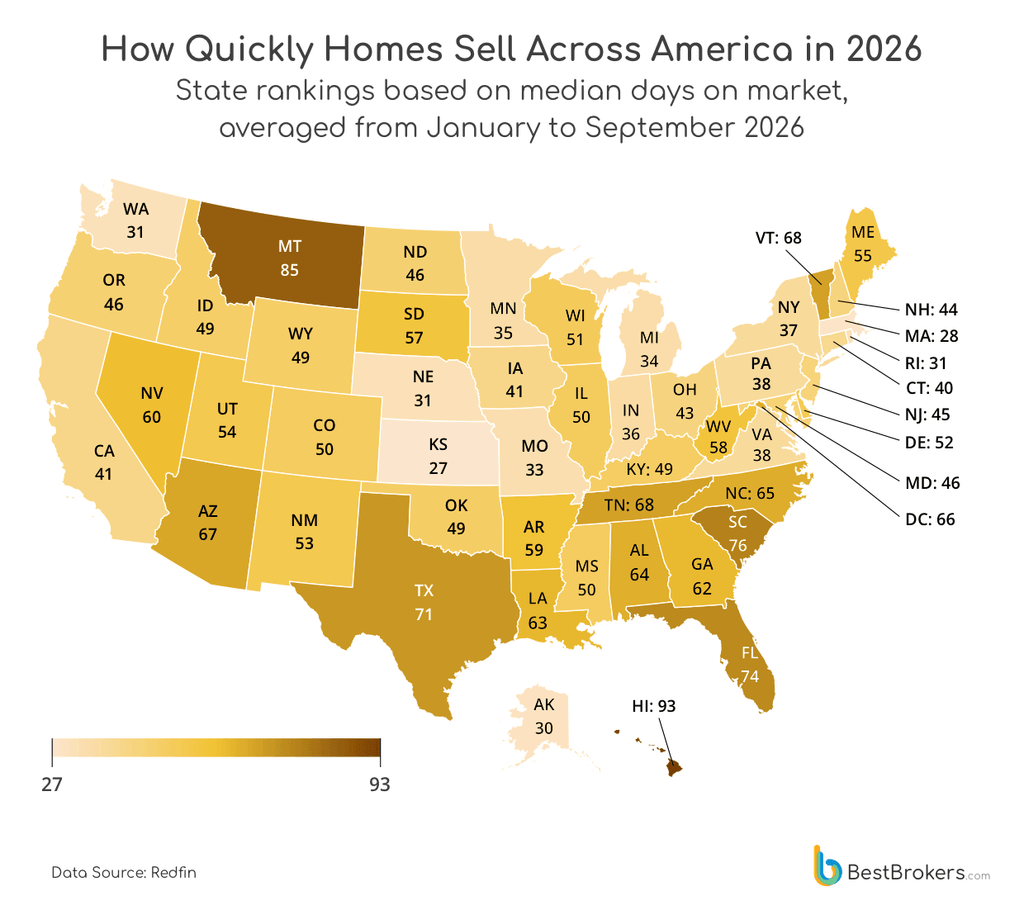
A new analysis of Redfin data (averaged from January through September 2026) puts the median days on market in Hawaii at 93 days — the highest of any state. For comparison, homes sell in a median of just 27 days in Kansas and 28 days in Massachusetts. Montana (85 days), South Carolina (76), Florida (74), and Texas (71) are also notably slow, while much of the Northeast and parts of the Midwest remain relatively brisk.
The map circulating from BestBrokers.com (based on the same Redfin data) makes the contrast clear: Hawaii stands out in the darkest shade.
What the numbers show for Hawaii
According to the BestBrokers analysis of Redfin data:
- Median sale price: Roughly $744,000 (second-highest in the country, just behind California’s ~$752,000).
- Share of homes selling above asking: Only about 15.7% — well below California’s 32.6% and far below the strongest Northeast markets (Connecticut ~52%).
- Homes are taking more than three times longer to sell in Hawaii than in Kansas.
Redfin’s own September 2026 statewide snapshot is consistent with the longer trend: median days on market of 94 days (up 29 days year-over-year), median sale price of $752,837 (+0.5%), homes sold down 32%, and roughly 8 months of supply.
This combination — high prices + longer time on market + limited bidding wars — is the hallmark of a cooler, more balanced-to-buyer’s market.
Why Hawaii is different
Several structural factors help explain the ranking:
- Price level — At nearly $750,000 median, the buyer pool is smaller. Higher prices naturally lengthen marketing time almost everywhere.
- Geography and inventory mix — Statewide figures include all islands and all property types. Neighbor-island markets (especially Maui and Kauai) and the condominium segment tend to move more slowly than Oahu single-family homes.
- Supply — Months of supply has risen, giving buyers more choice and reducing urgency.
- Demand softness — Higher mortgage rates and the overall cooling seen across many Sun Belt and coastal markets have reduced the number of aggressive buyers.
Important local context for Oahu
Statewide averages can mask significant variation. Local MLS data for Oahu has shown single-family homes selling substantially faster than the statewide median in recent months (often in the teens for median days on market for single-family homes). Condos and neighbor-island properties pull the statewide number higher.
In practical terms, a well-priced single-family home on Oahu in a desirable neighborhood can still move relatively quickly, while a higher-priced listing, a condo, or a property on a neighbor island is more likely to sit closer to (or longer than) the statewide average.
What this means for sellers and buyers
For sellers:
- Price with current comps, not last year’s peak expectations. Overpricing is the most common reason listings linger.
- Expect a longer marketing period than in 2021–2022, especially above the median or in slower submarkets.
- Preparation (condition, staging, professional photos, and pricing strategy) matters more when buyers have options.
- On Oahu, the single-family segment remains healthier than the statewide headline number suggests, but competition from other listings is real.
For buyers:
- You have more time and more negotiating leverage than in recent years.
- Inventory is higher and the share of homes selling above list is relatively low, which creates opportunities for price reductions and inspection/negotiation room.
- Still be ready to move on well-priced, well-located properties — the best ones continue to attract interest.
Bottom line
The map is accurate: Hawaii currently has the longest median days on market of any state. That reflects high prices, increased supply relative to demand, and a cooling national market. It does not mean every property takes three months to sell — especially on Oahu for single-family homes — but it does mean the overall environment is more buyer-friendly than it has been in years.
Sellers who price accurately and present their homes well can still succeed. Buyers who are patient and prepared have more leverage than they did during the peak years.