“It is somewhat puzzling that home sales would fall to levels last seen three decades ago, even as the U.S. population has grown by roughly 75 million. Either sizable housing demand is building in the background, or the dream of homeownership is increasingly out of reach for many Americans.”
— Lawrence Yun, Chief Economist, National Association of Realtors
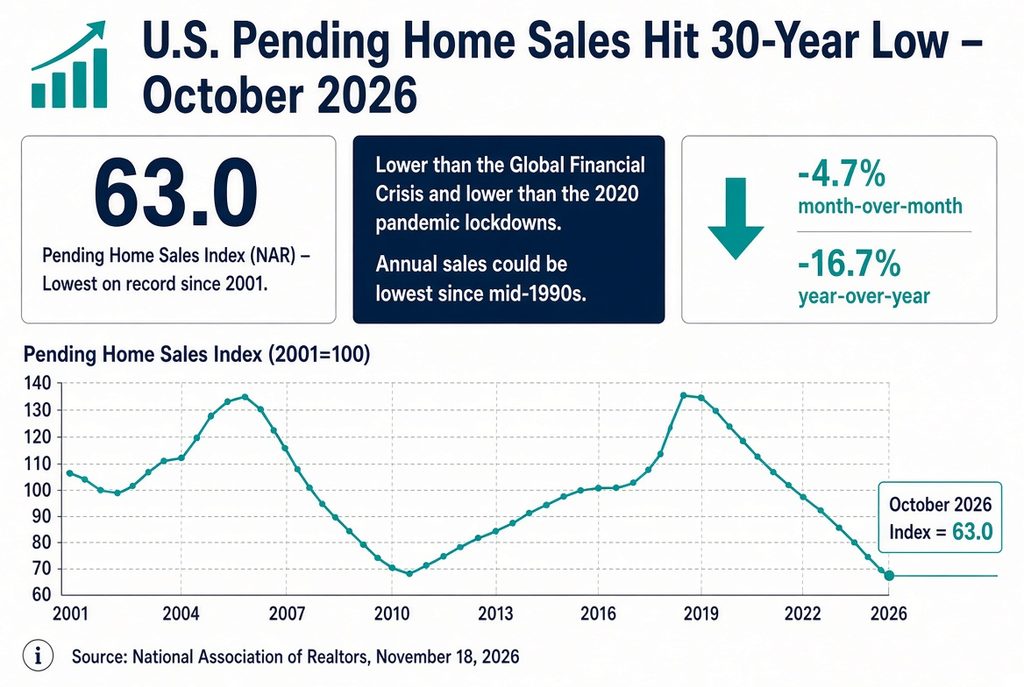
That’s the quote that stopped a lot of people in their tracks this week. Pending home sales — the number of signed contracts on existing homes — just hit levels that point to the weakest annual sales volume since the mid-1990s. And Yun is right to call it puzzling.
The numbers
In October, the National Association of Realtors reported that pending home sales fell 4.7% from September and 16.7% from a year earlier. NAR’s Pending Home Sales Index dropped to 63 — the lowest reading since the series began in 2001 (where 100 equals 2001 activity). It was the second consecutive month of record lows.
Those contracts become closed sales one to two months later. Existing-home sales already slowed to an annualized pace of 3.75 million in October — the lowest in 16 years and comparable to Great Recession levels. Yun said full-year 2026 existing-home sales could finish as the lowest since the mid-1990s.
Same sales volume, 75 million more people
Thirty years ago the U.S. population was roughly 75 million smaller. Yet the volume of homes changing hands is on track to match (or undercut) those mid-1990s levels. That gap between population growth and actual transactions is what makes the current freeze so striking.
The main drivers are familiar but still powerful:
- Mortgage rates that recently pushed into the 7%+ range
- Home prices that remain elevated relative to incomes, pushing monthly payments sharply higher for most buyers
- Existing owners locked into much lower rates who have little incentive to sell
- Builders responding to weak single-family demand by shifting more production toward multifamily units
What it means going into winter
The next couple of months of closed sales will reflect these extremely low contract levels, so the winter market is expected to stay quiet. For buyers who can still qualify and afford the payments, the environment is less competitive than it has been in years — more inventory to choose from and more willingness from sellers to negotiate. For everyone else, the market remains largely frozen.
Yun’s comment captures the tension clearly: either a lot of pent-up demand is quietly building, or homeownership is simply moving further out of reach for a larger share of the population. Right now the data is pointing more toward the second explanation.